






How to Use Locals Frequently Asked Questions and Help Topics:
https://support.locals.com/en/article/how-do-i-upload-videos-podcasts-photos-r49es4/
If you need more help contact LOCALS Support at:


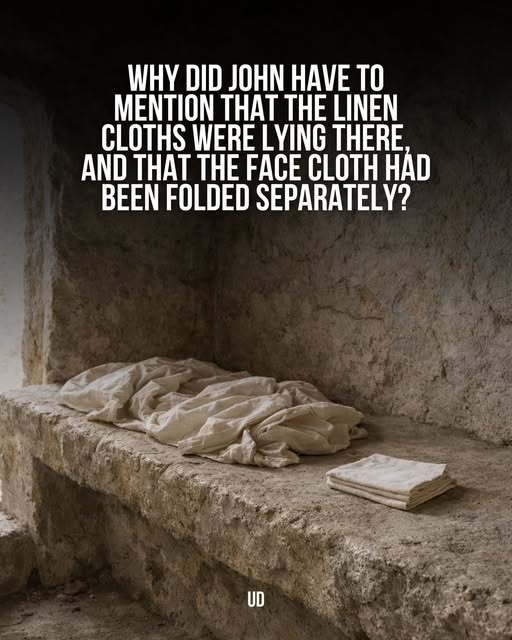
As I read John’s account of the resurrection, I was struck by how restrained his writing is.
He did not begin with an explanation
or a theological conclusion.
He recorded what exactly was seen,
in the order it was seen, and allowed
the details to carry weight on their own.
When Peter entered the tomb,
John tells us that he saw the
linen burial cloths lying there.
Then John adds a specific
and seemingly minor detail.
The cloth that had covered Jesus’ head
was not lying with the other cloths.
It was folded and placed separately.
At first, this detail did not seem necessary.
It could easily be passed over.
But throughout John’s Gospel,
details are never incidental.
John consistently includes concrete
observations at key moments,
often before their meaning
is fully understood.
That pattern made me pause
and ask why this detail was preserved.
Jewish burial practices in the
first century help clarify the scene.
The body of the dead was wrapped
tightly in linen cloths, along with burial spices.
These wrappings were not
temporary coverings.
They marked the finality of death.
Once applied, the cloths were
meant to remain in place.
With this background,
the condition of the tomb
becomes significant.
If Jesus’ body had been stolen
like what some people assumed then,
there would have been no reason
to remove the wrappings.
Taking the body without the cloths
would have been impractical
and downright disrespectful.
If the resurrection had occurred
in confusion or haste, the cloths
would likely have been left
disturbed or scattered.
But John tells us neither of these happened.
The burial cloths remained.
The face cloth was folded.
Nothing in the tomb suggested
panic, interruption, or struggle.
What John describes points
instead to intention and order.
This fits with how John presents
Jesus throughout the Gospel.
Jesus repeatedly states that
He will lay down His life willingly
and that He has authority
to take it up again.
The resurrection is not portrayed
as an escape from death,
but as an act that remains
under His authority even
after death has been fully entered.
The folded burial cloths
quietly support this portrayal.
They indicate that the burial process
had come to its proper end and that
death’s claim had been exhausted.
The body was gone,
not because it had been taken away,
but because it no longer belonged
to that grave anyway.
This detail also resonates with Jesus’
final words on the cross, “It is finished.”
In John’s Gospel, those words
signal completion, not interruption.
The resurrection did not undo the cross,
it confirmed that the work accomplished
there stands complete.
The calm order of the tomb
reflects that finality.
Nothing is hurried.
Nothing is left unresolved.
John allows physical details to speak
before explanations are given.
Before angels appear,
and before the disciples
understand what has happened,
the tomb itself bears witness.
The reader is invited to observe carefully,
just as the disciples did.
John includes the details
of the folded burial cloths
because it matters.
It shapes how the resurrection is understood.
What occurred was not chaos followed by correction.
It was completion followed by quiet authority.
Don Lemon involved in MN Church Invasion!
Then he baits the DOJ to arrest him after others got arrested for the Church invasion!
DOJ responds with "Okay".
Then Don Lemon gets arrested!
B💣💣M!!

How to Use Locals Frequently Asked Questions and Help Topics:
https://support.locals.com/en/article/how-do-i-upload-videos-podcasts-photos-r49es4/
If you need more help contact LOCALS Support at: