




How to Use Locals Frequently Asked Questions and Help Topics:
https://support.locals.com/en/article/how-do-i-upload-videos-podcasts-photos-r49es4/
If you need more help contact LOCALS Support at:


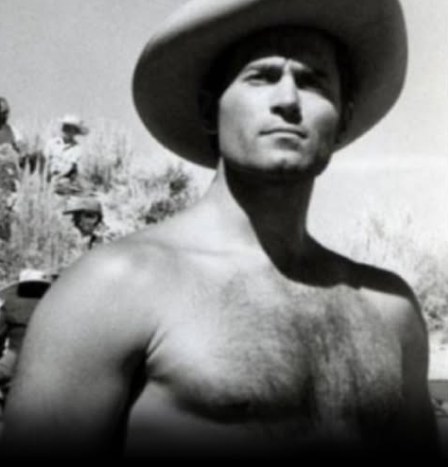
Norman Walker wasn't supposed to be famous.
He was just a big, quiet man doing big, quiet work — merchant marine, factory floor, deputy sheriff badge, security guard uniform. Whatever the job needed, he showed up for it. No complaints. No shortcuts. He stood 6 feet 6 inches tall and moved through the world like he had nothing to prove, because he didn't.
That's exactly why a Hollywood producer noticed him.
In 1955, a Warner Bros. executive spotted him working the floor of the Sahara Hotel in Las Vegas. Not performing. Not auditioning. Just working. The producer took one look and thought: That's a frontier hero.
He offered Norman a screen test and a new name: Clint Walker.
What followed was television history.
Cheyenne premiered on September 20, 1955, and it broke the mold immediately. Every Western before it had been a half-hour show. Cheyenne was a full hour. Longer stories. Deeper characters. A hero with room to breathe.
And Clint Walker — the security guard with zero acting training — carried every minute of it.
His character, Cheyenne Bodie, was a drifter. A former frontier scout who rode from town to town, helped people in trouble, then disappeared before anyone could properly thank him. No fanfare. No reward. No need for applause.
Walker played him the only way he knew how: quietly.
He didn't shout his way through scenes. Didn't perform toughness. His voice was low and steady, like wind moving through canyon walls. His silences said more than most actors' monologues. Week after week, viewers leaned toward their television screens, drawn in by a man who didn't seem to need them watching.
For eight years and 108 episodes, America watched.
Cheyenne made Clint Walker one of the most recognizable faces on television. But fame, to Walker, was just noise. He wore celebrity like a coat he could take off — casually, without fuss. No tabloid drama. No public feuds. He went to work, he came home, he lived simply.
Then, in 1971, everything almost ended.
Walker was skiing at Mammoth Mountain in California when he lost control on the slope. In the crash, a ski pole drove straight into his chest — puncturing his heart.
His heart stopped.
Doctors worked frantically. The damage was catastrophic. Most people don't survive a pierced heart, let alone one that has already stopped beating. Most people would have been carried off that mountain and never come back.
Clint Walker came back.
After emergency surgery and weeks of grueling recovery, the man who'd spent eight years playing an indestructible frontier hero walked out of that hospital on his own two feet.
Then he went back to work.
He kept acting for four more decades. Stayed strong and fit into his eighties. Avoided the spotlight. Lived quietly with family. Never wrote a dramatic memoir about everything he'd survived. Never turned his near-death into a brand.
He just kept going. The same way he always had.
On May 21, 2018, nine days before his 91st birthday, Clint Walker passed away peacefully.
The tributes that poured in weren't about controversy or spectacle. They were about something rarer: a man who lived, from first day to last, with genuine dignity.
Here's the thing about Clint Walker that stays with you.
In a world that keeps telling us that strength means being the loudest person in the room — the most aggressive, the most visible, the most aggressively self-promoting — he was living proof that it doesn't.
Cheyenne Bodie never drew first. Never raised his voice unless someone was in danger. Never asked for credit.
Neither did Clint Walker.
He was discovered by accident, became a star without trying, survived the unsurvivable, and walked away from it all without making a fuss.
That's not a character from a script.
That's just who he was.
And in a world that often mistakes noise for power, his life is a quiet, steady reminder:
The strongest people in the room are rarely the ones making the most noise.
They're the ones who don't need to.
TrumpIRA.gov Available early 2027!
This is an incredible opportunity for those that may not have access to traditional IRA's.
Trump used an Example of a 25 year old that begins and the estimated value of $465,000 by age 65 (for that same individual):
$165 each month + Trump matched up $1000
Let's do the math:
$165 x 480 months = $79,200 indiv. deposits.
$1000 x 40 (each year Trump matches) = $40,000
Equals $119,200
Trump says that account estimate will be $465,000
that means the growth of that account is $345,800!
Trump Economy will be EXPLOSIVE!!!
Any day now, the Supreme Court will hand down its ruling in Trump v. Barbara, the case that will decide whether the 14th Amendment really does what the open-borders crowd has been pretending it does for decades.
And honestly, the meme below pretty much says it all.
Two illegal aliens having a baby on American soil shouldn't magically produce a brand new American citizen, complete with a Social Security number, access to taxpayer-funded benefits, and a chain migration pipeline for the rest of the family.
It should produce three deported illegal aliens. Mom, Dad, and the baby were all sent home together.
That isn't cruel, that isn't extreme, and that isn't some radical new idea. It's how virtually every other country on planet Earth handles citizenship.
No sane nation in the world hands out citizenship to the children of people who broke into the country, yet here we are, the United States, treating our most valuable possession like a party favor.
The 14th Amendment was written in 1868 to ...


How to Use Locals Frequently Asked Questions and Help Topics:
https://support.locals.com/en/article/how-do-i-upload-videos-podcasts-photos-r49es4/
If you need more help contact LOCALS Support at: