







How to Use Locals Frequently Asked Questions and Help Topics:
https://support.locals.com/en/article/how-do-i-upload-videos-podcasts-photos-r49es4/
If you need more help contact LOCALS Support at:


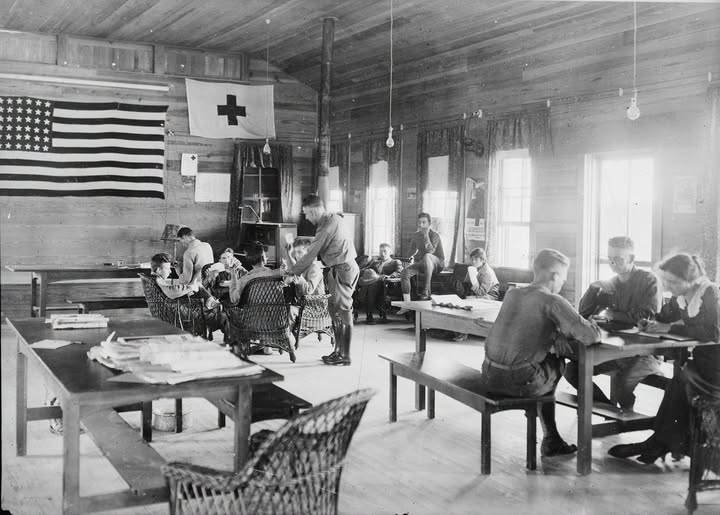
Soldiers in a Red Cross convalescent home in Marfa, 1919. I saw this photo and thought "Marfa is pretty far out in the middle of nowhere," why would they put it there? So I researched it.
The key to the puzzle is that the Red Cross did not choose actually choose Marfa as an isolated place to send wounded soldiers. The Army was already there in considerable strength. During World War I, Marfa was home to Camp Marfa, the installation later renamed Fort D. A. Russell. The post had originated in 1911 during the Mexican Revolution, when the Army stationed cavalry there to patrol the volatile Big Bend border. During World War I it expanded substantially, housing regular Army, National Guard and other units, and Marfa became an important headquarters for military operations along the Big Bend section of the Mexican border.
By 1918-19, Camp Marfa was becoming a fairly substantial installation. Permanent construction began in 1918, and by the end of 1919 it had a hospital and infirmary, officers' quarters, radio facilities, veterinary facilities, a motor pool and other support buildings. So my reading of this is that the Red Cross Convalescent House was essentially an amenity attached to an existing Army hospital, rather than a stand-alone sanitarium established because somebody thought Marfa would be a nice place for veterans to recuperate.
That said, I think Marfa's climate probably didn't hurt. At roughly 4,700 feet elevation, it had abundant sunshine, extremely dry air and relatively mild summer temperatures compared with much of Texas. Dry, high-altitude climates were widely regarded at the time as beneficial for people recovering from respiratory illnesses, particularly tuberculosis and pneumonia. After all, West Texas has always already attracted folks for just that reason. Also, the Army had just been hammered by the 1918 influenza pandemic, which killed large numbers of servicemen in camps throughout the United States.
There's another interesting piece of context: these Red Cross houses were a nationwide World War I program. The Red Cross built quite a few of them beside Army hospitals. They weren't hospitals themselves so much as comfortable halfway houses between the hospital ward and normal life, with fireplaces, reading rooms, games, writing desks, entertainment, and places for visiting relatives.
Aren't y'all glad I track down all of this essential information for y'all?

How to Use Locals Frequently Asked Questions and Help Topics:
https://support.locals.com/en/article/how-do-i-upload-videos-podcasts-photos-r49es4/
If you need more help contact LOCALS Support at: