



How to Use Locals Frequently Asked Questions and Help Topics:
https://support.locals.com/en/article/how-do-i-upload-videos-podcasts-photos-r49es4/
If you need more help contact LOCALS Support at:


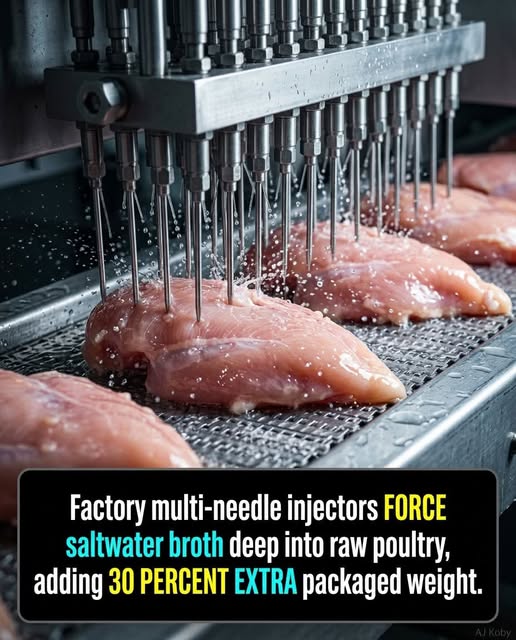
Plumping adds 30% liquid weight to raw supermarket chicken. 🚨
Industrial poultry lines use high-pressure machines equipped with hundreds of hollow needles to shoot a solution of water, salt, and sodium phosphate directly into raw meat tissue. The industry calls this process "plumping" or "enhancing," and it can account for up to 15 to 30 percent of the total product weight sitting on retail shelves. Because raw chicken sells by the pound, a consumer buying a $10 family pack can easily end up paying $3 for trapped saltwater.
The processing technique fundamentally alters both the cost and nutritional profile of basic poultry:
• Physical Mechanism: Multi-needle injection machines pierce raw muscle tissue, forcing liquid into internal cellular spaces where it stays trapped inside the packaged meat.
• Nutritional Impact: Standard raw chicken contains roughly 50 to 70 milligrams of naturally occurring sodium per four-ounce serving, but injected chicken can jump to over 400 milligrams per serving.
• Labeling Rules: Federal USDA regulations mandate that packages state terms like "contains up to 15% solution" on the front label, though the text is frequently printed in fine print along the bottom edge.
Beyond the immediate financial loss at the register, high-pressure injection creates food safety considerations. When hollow needles penetrate deep into intact muscle tissue, any surface bacteria present on the raw meat can be pushed directly into the center of the breast or thigh, requiring strict internal cooking temperatures of 165 degrees Fahrenheit to ensure safety. Checking the fine print on the lower edge of plastic wrap remains the only way to confirm if a tray contains pure poultry or added brine.
Check the fine print for added solution percentage next time you buy fresh chicken breast.
Have you noticed extra liquid pooling inside sealed chicken packages at your local store?
Sources:
• Primary: USDA Food Safety and Inspection Service (FSIS) 9 CFR Part 441 - Retained Water in Raw Meat and Poultry Products (2001)
• Secondary: USDA FSIS Water in Meat and Poultry Regulatory Guidelines (2016)
#AJKoby #FoodSafety #ConsumerProtection #GroceryTruths #FactoryFarming See less

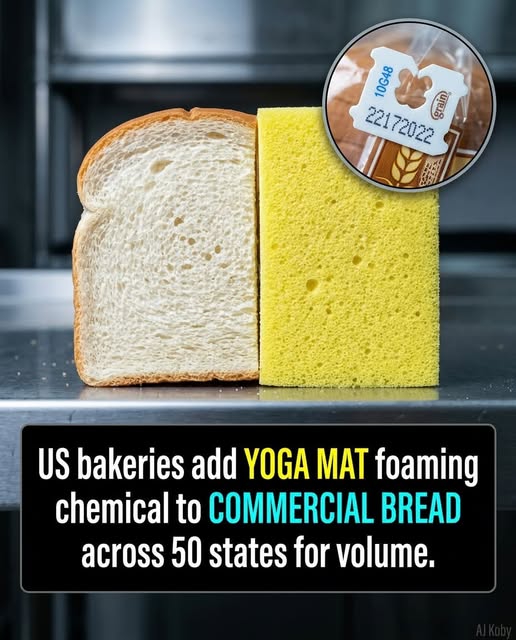
US bread uses a plastic-foaming chemical banned in Europe 🍞
When commercial bakeries need to process hundreds of thousands of loaves a day, they turn to azodicarbonamide (ADA)—a synthetic compound listed in 21 CFR 172.806. While industrial foam manufacturers inject it into plastic resin to expand it for use in yoga mats, shoe soles, and floor underlayment, industrial bread factories pour it directly into flour mixers. It serves two functions: instantly bleaching the grain and strengthening the gluten matrix so that high-speed factory hooks don't tear the dough.
• The Industrial Purpose: ADA releases tiny gas bubbles during mixing, making commercial loaves rise faster, look whiter, and hold structural volume with less aging time.
• The Regulatory Divide: The FDA allows ADA in flour up to 45 parts per million (0.0045%), whereas the European Union banned it entirely under Regulation (EC) No 1333/2008 due to respiratory health risks for factory workers exposed to the raw powder.
• The ...

How to Use Locals Frequently Asked Questions and Help Topics:
https://support.locals.com/en/article/how-do-i-upload-videos-podcasts-photos-r49es4/
If you need more help contact LOCALS Support at: